
By The Eviga Journal | April 2026 | 9 min read
There is a number worth sitting with for a moment.
In 2024, life expectancy at birth across the Nordic countries reached 83.2 years — the highest recorded since measurements began, and for the first time exceeding pre-pandemic levels. Sweden sits at the top of that figure with a life expectancy of 84.1 years. For context, the global average is closer to 73. That is not a small gap. That is more than a decade of additional life, on average, separated by geography, culture, and the choices embedded in daily existence.
The question worth asking is not just how long Scandinavians live. It is how well they live while doing it.
This Is Not a Story About Superfoods
The wellness industry would have you believe that longevity is something you purchase. That the right supplement stack, the correct morning routine, the perfectly optimised diet will add years to your life if you just spend enough money on it. Walk through the health section of any bookshop and you will find shelf after shelf of books promising the same thing in slightly different packaging.
Scandinavia quietly dismantles that story.
Nordic countries consistently show some of the lowest rates of heart disease, diabetes, and obesity in the developed world, yet you will not find supplement stores dominating Stockholm’s shopping districts or açai bowls on every corner in Copenhagen. What they have is something far less commercially interesting and far more difficult to bottle: a philosophy about how life should be lived.
That philosophy is worth understanding — not to romanticise another culture, but because the evidence suggests it genuinely works.
The Concept That Changes Everything
The Norwegian word friluftsliv translates roughly as “open air life.” It describes a way of relating to the natural world that is not recreational or aspirational but simply ordinary. You go outside because you are alive and being alive means moving through the world, in all weathers, across all seasons. Not as exercise. Not as self-improvement. Just as life.
This is not a concept invented by a wellness brand or popularised by a podcast. It is a cultural inheritance, passed quietly between generations, expressed in the sight of children playing outside in January sleet and adults cycling to work through a Nordic winter without apparent complaint.
The health implications of this are significant. Regular moderate movement, accumulated across a lifetime rather than compressed into gym sessions between long periods of sitting, is one of the most robustly supported factors in healthy ageing. The research does not need to be complicated. People who move consistently throughout their days, embedded in that movement as habit rather than discipline, tend to live longer and with fewer chronic conditions than those who do not.
Scandinavians have not discovered this through research. They have simply never stopped doing it.
The Numbers Behind the Philosophy
All Nordic countries exceeded the global life expectancy in the Global Burden of Diseases Study, with the highest female life expectancy recorded in Iceland at 85.9 years compared to 75.6 years globally. These are not marginal differences. They represent years of additional healthy life — years spent active, cognitively sharp, and engaged with the world rather than managing the consequences of decline.
What drives those numbers is not one thing. Research analysing data from the Global Burden of Diseases Study suggests it is their health systems and lifestyles, not any magical dietary intervention, that make the difference.
Those lifestyle factors include things that are difficult to turn into products. Trust in institutions. Economic security. Cities designed for walking and cycling rather than driving. Work cultures that protect rest and family time. Universal healthcare that removes the chronic low-level stress of financial exposure to illness. These are structural conditions that create an environment where healthy choices are the default rather than the exception.
But within that structure, there are individual habits worth examining closely.
What They Actually Do Differently
They eat food. Real food.
The Nordic diet is not a trend. It is what people have eaten for generations in a cold climate where certain things grow and others do not. Fish, particularly fatty fish rich in omega-3s. Root vegetables. Whole grains. Berries. Some studies show that people who eat at least two servings of fatty fish per week have a lower risk of cardiovascular disease, likely because the long-chain omega-3 content reduces inflammation in arteries. This is not a discovery. It is something Scandinavians have done naturally for centuries.
What they do not do, in general, is eat ultra-processed food in the volumes seen elsewhere. Not because of discipline or ideology but because the food culture simply developed differently.
They sit in saunas.
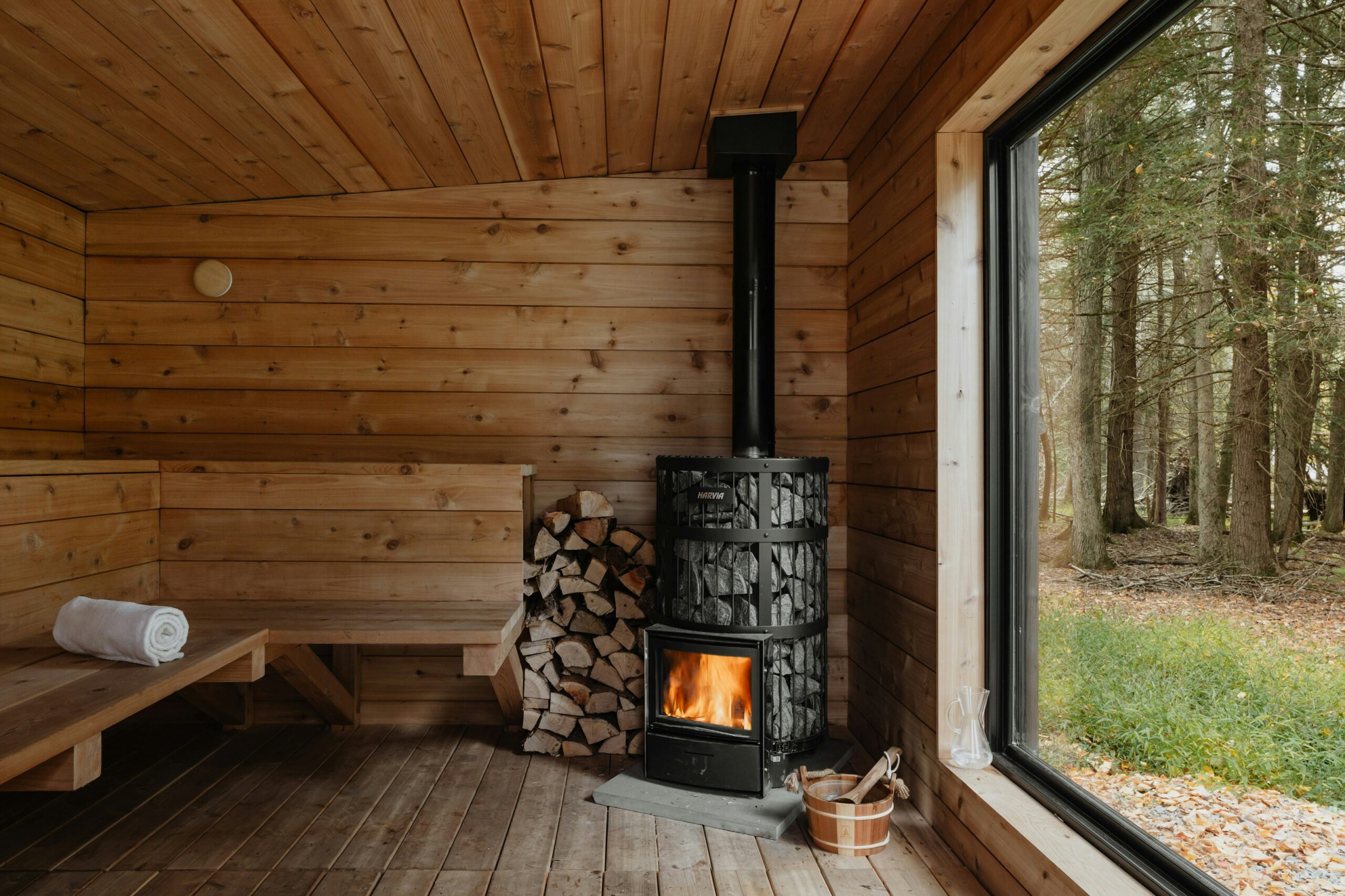
The sauna is not a spa luxury in Finland or Sweden. It is an ordinary part of life, used multiple times per week by a significant proportion of the population. The benefits of sauna use include improved cardiovascular function, improved circulation, and deep relaxation — the heat also helps loosen muscles and ease pain. iHerb More recent research has extended these findings significantly, with regular sauna use associated with reduced risk of cardiovascular disease, improved immune function, and measurable effects on stress hormones.
We will explore the science of heat therapy in depth in a dedicated Journal piece. For now, it is enough to say that this is one of the most consistent, cross-generational health practices in the Nordic world, and the research supporting it has grown substantially in recent years.
They rest without guilt.
The concept of lagom, the Swedish idea of “just the right amount,” resists the harder-faster-longer mentality that defines much of modern professional life. Scandinavians, broadly speaking, work reasonable hours, take their holidays, and consider rest a component of performance rather than an obstacle to it. Work-life balance is protected through flexible hours, generous parental leave, and ample vacation time — and quality of life takes priority over quantity of things.
Chronic stress is one of the most significant contributors to accelerated biological ageing. Elevated cortisol suppresses immune function, increases inflammation, disrupts sleep, and over time, degrades the cellular machinery that keeps us healthy. A culture that structurally protects people from chronic overwork is also, in ways that are hard to measure directly, protecting their cells.
They are rarely alone.
Folks from nations like Finland are more likely to eat together, and this subtle difference gives Scandinavians an important social boost that enhances happiness and increases well-being, combating memory loss in later life. Social connection is one of the strongest predictors of longevity in the research literature, comparable in effect size to smoking or physical activity. Isolation, conversely, is associated with significantly elevated mortality risk. The Scandinavian habit of community, whether around a shared meal, a sauna, or an outdoor walk, is not incidental to their health outcomes. It is part of the explanation for them.
The Honest Caveat
It would be dishonest to present Scandinavian longevity as purely a product of lifestyle and leave it there.
Universal healthcare, robust social safety nets, low poverty rates, and high levels of economic equality all create the conditions within which healthy lifestyles can take root. These are not things that individuals can simply adopt by changing their habits. They are the product of specific political and economic choices made over generations. Any honest account of Nordic longevity has to acknowledge that context.
What individuals can borrow, though, are the habits — the daily movement, the regular heat exposure, the real food eaten with other people, the protected rest. These things do not require a Nordic postcode. They require a decision about how to spend a life.
What This Has to Do With Eviga
The word eviga means eternal. When we chose it, we were not thinking about living forever in any literal sense. We were thinking about the Scandinavian understanding that vitality is not something that happens to you or is taken from you. It is something cultivated, quietly and consistently, across a lifetime.
Modern longevity science, including the research into NAD+ decline, cellular repair, and the supplements that support these processes, is in many ways catching up to what Nordic cultures have practised intuitively for centuries. The two are not in tension. They are the same idea expressed in different languages.
That is the conversation The Eviga Journal intends to have.
Next in this series: The Science Behind the Sauna.
This article is for informational and educational purposes only. Nothing here constitutes medical advice.
Last updated: April 2026